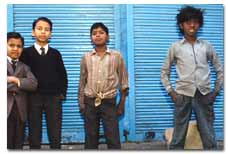
Reaching youngsters at an impressionable age before they become sexually active can lay the foundation for a responsible lifestyle, including healthy relationships and safe sex habits. NACO reaches out to youth through specially developed Adolescent Education Programme focused primarily on prevention through awareness building.
The Adolescent Education Programme was one of the key policy initiatives of NACP II. Ministry of HRD and NACO collaborated to develop this school-based programme that is implemented across 144,409 secondary and senior secondary schools with the objective of reaching out to about 33 million students within two years. AEP is implemented by the Department of Education in collaboration with the State AIDS Prevention and Control Societies.
The Adolescence Education Programme (AEP) aims at:
• Co-curricular adolescence education in classes IX-XI
• Curricular adolescence education in classes IX-XI and life skills education in classes I- VIII
• Inclusion of HIV prevention education in pre-service and in-service teacher training and teacher education programmes.
• Inclusion of HIV prevention education in the programmes for out-of-school adolescents and young persons, and
• Incorporating measures to prevent stigma and discrimination against learners/students and educators and life skills education into education policy for HIV prevention.
Under the programme, teachers and peer educators are trained, who, in turn, conduct the programme amongst the student community. The programme covered 112,000 schools and trained 2,88,000 teachers. They have been provided reference material, which has been developed by NACO in collaboration with Ministry of HRD and vetted by NCERT.
Initiatives for Out-of-school Youth
A large number of young people aged 10-25 years, belonging to diverse groups of several sub-sets in terms of marital status and social background, are out of school in India. Their vulnerability to HIV/AIDS is particularly high owing to their limited understanding of the infection. Since there is no proven model for reaching out to ‘out-of-school youth’, a number of district-wide innovative programmes are initiated in all the states.
An analysis of 80 such youth-centric HIV prevention programmes provides a menu of options and tools for a scale-up for this target group. SACS are also implementing district-wide programmes on peer education to ensure coverage of 80 percent out-of-school youth in 59 high prevalence districts of India. Apart from this access to youth-friendly health services like counselling and treatment for STIs are being stepped up. Greater dialogue is being generated through innovative formats and platforms. Relevant messages on safe sex, sexuality and relationships are developed and disseminated for youth via posters, booklets, panels, hoardings and printed material
To know more about this,click on below link...
 Bihar PIP 2008-09 National PIP on ARSH

Call: 0612-2265896
Adolescence Education Programme (AEP)